Turn the Page

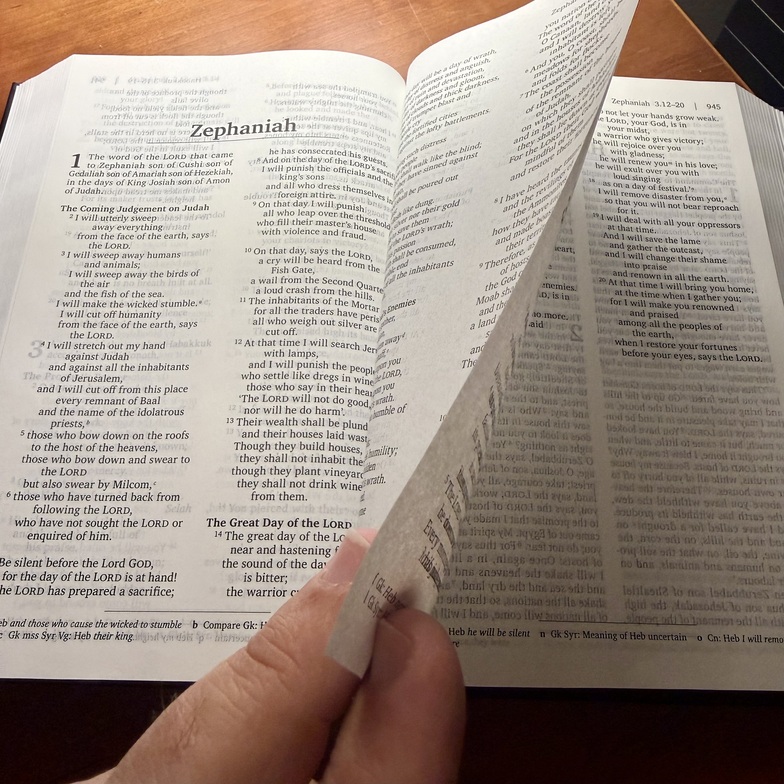
In this weekend's Hebrew Bible reading from Zephaniah, we hear a harsh word from the Lord.
"The great day of the Lord will be a day of wrath, a day of distress and anguish, a day of ruin and devastation, a day of darkness and gloom ... I will bring such distress upon people that ... their blood shall be poured out like dust and their flesh like dung ... On the day of the Lord's wrath, in the fire of his passion the whole earth shall be consumed, for a full, a terrible end he will make of all the inhabitants of the earth."
excerpts from Zephaniah 1:16-18
Wow. Sounds fun, eh?
If this this were the only passage of Scripture you had, if this was the only word of God you could read, you would rightly despair. These few verses tell of God's wrath, punishment, violence, and destructive will in excruciating and dramatic detail. Verse 18 promises the end of all life on earth. This passage, on its own, is incredibly disturbing.
Can you imagine a sermon based only on these verses? What would such a sermon tell us about God? Could it even be done? Should such a sermon even be preached? Reading isolated passages apart from their broader context is risky business. If we just focused on Zephaniah 1:16-18, we'd have no hope.
And yet ... these verses are not the only verses of Scripture we have. In fact, they're not even the only verses we have in the short book of Zephaniah. So, let's not stop at Zephaniah 1:18. Let's keep reading. Let's turn the page.
Turn the page in your Bible to Zephaniah 3:14-20, where the Lord declares not ruin but restoration; the Lord promises salvation rather than suffering. Yes, Zephaniah 3 tells of God's love, victory, and joy. "The Lord has taken away the judgements against you ... the Lord, your God, will rejoice over you with gladness; he will renew you in his love; he will exult over you with loud singing as on a day of festival."
It seems, dear reader, that God's mercy endures forever. We've heard that one before (Psalm 136; Psalm 100:5; 1 Chronicles 16:34; 2 Chronicles 5:13, 7:3, 20:21; Ezra 3:11; etc.)
Whenever you hear a preacher on TikTok, or see a meme on Facebook, or drive past a highway billboard that is nothing but divine anger and judgement, ask yourself a question - what's on the next page? We know that judgement is part of the story, but it is not the whole story. What's on the next page? We know that suffering is a consequence of sinful living, but we also know that God forgives sin, raises the dead, and makes new creations out of old. Ask yourself, what's on the next page?
We do not read Scripture in isolation. We do not surgically remove verses to fashion them into idols for worship, nor do we wield solitary verses as weapons against our perceived enemies (ahem, we are to love our enemies and pray for them, not use weapons against them!).
One of the techniques we can use to understand difficult verses, verses that don't seen to rhyme with what we know of God's nature or of our calling as Christians, is to ask, "what's on the next page?" Because we often don't have to read long to see a broader context, or to complete a narrative arc, or to find complementary imagery that helps paint a rich, nuanced, complex, and deeply compelling picture of our God and of our holy calling as Christians.

-
Location